

Marketplace connection – Sell effectively where your customers are
Sell where your customers are searching – on eBay, Amazon, DAPARTO, TYRE24, Kaufland.de and other marketplaces!
Seamlessly connect all important online marketplaces with minimal effort – this is how marketplace connection works in our Speed4Trade CONNECT solution. A single middleware handles communication between your ERP system and the marketplaces and ensures real-time data exchange and synchronisation.
Our integration platform offers interfaces to the largest and best-known online marketplaces in the world.

Table of contents
- Currently connected online marketplaces
- Your advantages of online marketplaces
- Low risk, plenty of opportunities
- Customise individually – distribute automatically
- One solution for all sales channels
- Mark and refine offers for each sales channel
- Marketplace integration in just a few steps!
- Reliable parts identification and accurate search results
- Sales planning and automated listing
- Control of order processing
- Support for customer communication and after-sales processes
- Buying behaviour has changed
- What does that mean for retailers?
- What are marketplaces?
- What does marketplace integration mean?
- Benefits of marketplace integration
- How does the marketplace connection work?
- Requirements for successful marketplace integration
- Manage sales channels in one place
- Seamless process integration
- Expand sales strategies
- Tap into new markets – with minimal risk
- Data management
- Flexible technology
Currently connected online marketplaces
B2B online marketplaces






B2C online marketplaces













We will show you how to quickly connect new marketplaces.
Your advantages
- Additional sales channels added quickly
- Minimal personnel and financial effort for setup and customisation
- Full automation; systematic and reliable integration into existing processes
- Modular design
- Maximum flexibility and customisation possible
Low risk, plenty of opportunities
Stock levels, offers, orders, and communication are all exchanged and synchronised bidirectionally. Speed4Trade CONNECT enables continuous and complete integration of your ERP systems with the marketplaces – including real-time synchronisation and data exchange. And in the background, we ensure that everything remains up to date from a technical perspective.
You can take advantage of the wide reach and strong brand recognition of major platforms quickly, with minimal technical effort and low investment risk – a great extension to your own online shop! The modular structure allows you to add new channels in just a few steps.
With Speed4Trade CONNECT, you can apply your own terms on each marketplace and adapt all offers to the specific requirements and possibilities of each platform – without significant additional effort.
This applies, for example, to the display of meta data, the structure of offer texts, but also to pricing and offer design, discounts, etc. – everything can be set globally or in a highly granular manner for individual platforms. Tailored entirely to your needs and the requirements of your target groups.
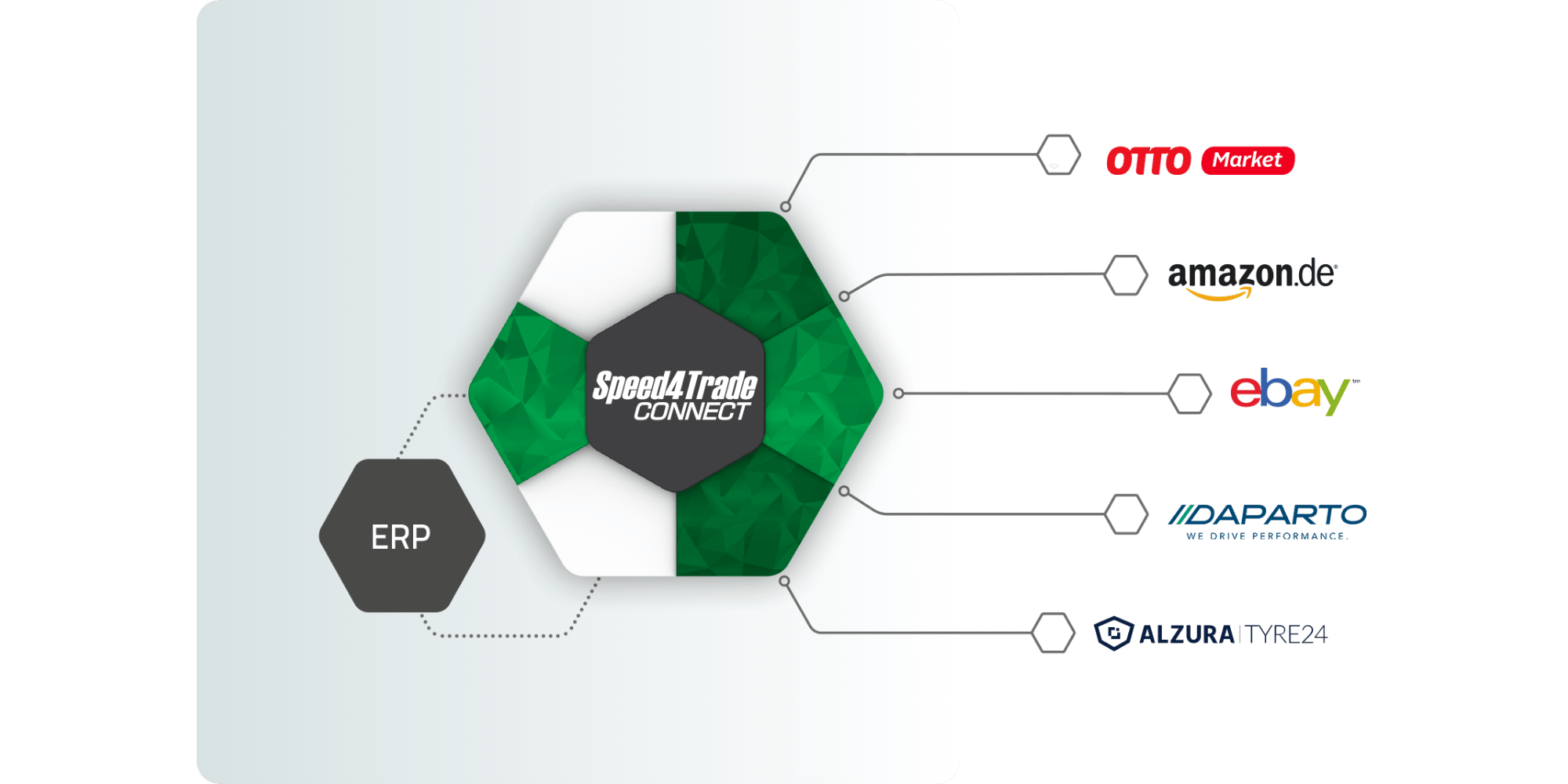
May we introduce Speed4Trade CONNECT?
We would be happy to show you how marketplace integration can also be used for your online business.
Customise individually – distribute automatically
With Speed4Trade CONNECT, you can target different customer groups on various marketplaces using individual sales strategies. To do this, you have access to customised offer templates in your corporate design, for example on eBay, as well as modules and placeholders for texts and product images.
Once you have configured all marketplace-specific settings (e.g. categories, prices, payment methods, shipping costs or special attributes), automation takes care of most of the work for you. This ensures that even extensive product ranges are transferred securely.
The interactive stock reconciliation then synchronises inventory levels and quantity distribution across all marketplaces and other sales channels.
Thanks to the modular middleware, changes to your sales strategy can be flexibly implemented via the interfaces. You benefit from an e-commerce model tailored to your needs and a reliable system that is always up to date.
Effective product listing with Speed4Trade CONNECT
- Individual sales strategies possible
- Listing templates, modules, and placeholders for appealing offers
- Stock synchronisation prevents overselling
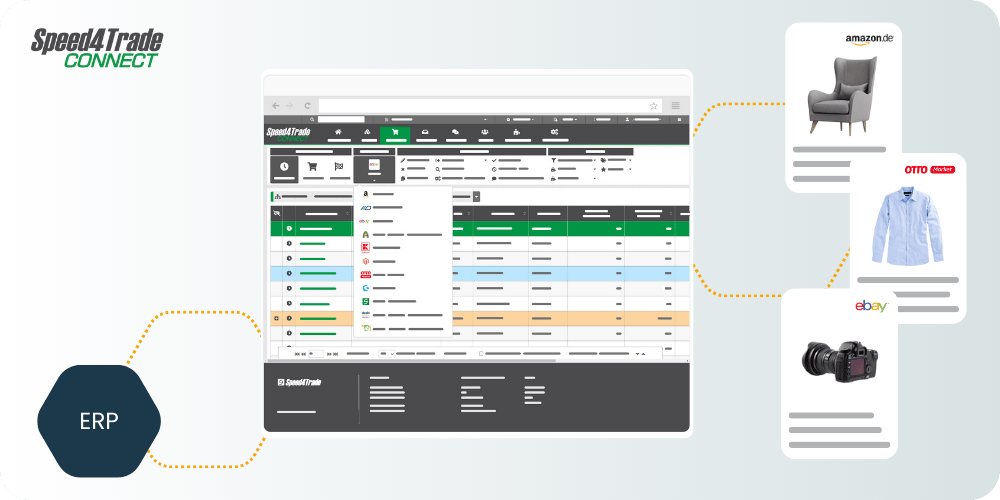
One solution for all sales channels
With a central middleware, you can connect to all major online marketplaces where your customers are active. With Speed4Trade CONNECT, you can rely on efficient processes and seamless marketplace integration through proven interfaces.
Thanks to flexibly programmable interfaces (APIs), e-commerce processes can be seamlessly integrated into the ERP user interface of systems such as SAP and others. The result: highly automated, integrated product and transaction management across all channels.
Do you want to test new markets and explore new opportunities? Online marketplaces allow you to test whether new regional and international sales opportunities can be developed in a promising way with minimal effort.
Scalable high performance with Speed4Trade CONNECT
Our marketplace connection solution can easily handle large amounts of data and scales even with extreme customisation. We support customers with over 3 million items who generate more than 500,000 orders per month via their marketplace connections.
Mark and refine offers specifically for each channel
Your products are complex and can be described in many different ways – but not every categorisation fits every platform. On a general B2C platform like Amazon, different attributes may be suitable than on a specialised B2B marketplace such as ALFAH Parts.
To refine attribute-rich product ranges for digital commerce, an agile middleware is essential. Similar to a PIM (product information management) system, attributes are adapted (mapped) for each individual marketplace independently of your ERP and then automatically displayed for each specific channel. Freely definable attribute names and values, along with smart attribute sets, ensure targeted and well-classified product listings – while the data in your ERP system remains unaffected. This prevents inconsistent data.
The database for sales-promoting attributes can originate from an ERP system such as SAP or specific parts catalogues such as TecDoc for automotive spare parts. Time-consuming manual multiple attribute maintenance, which multiplies with each additional sales channel, is no longer necessary.
This allows you to implement efficient multichannel strategies with minimal effort, ensuring your products are discovered in the best possible way.
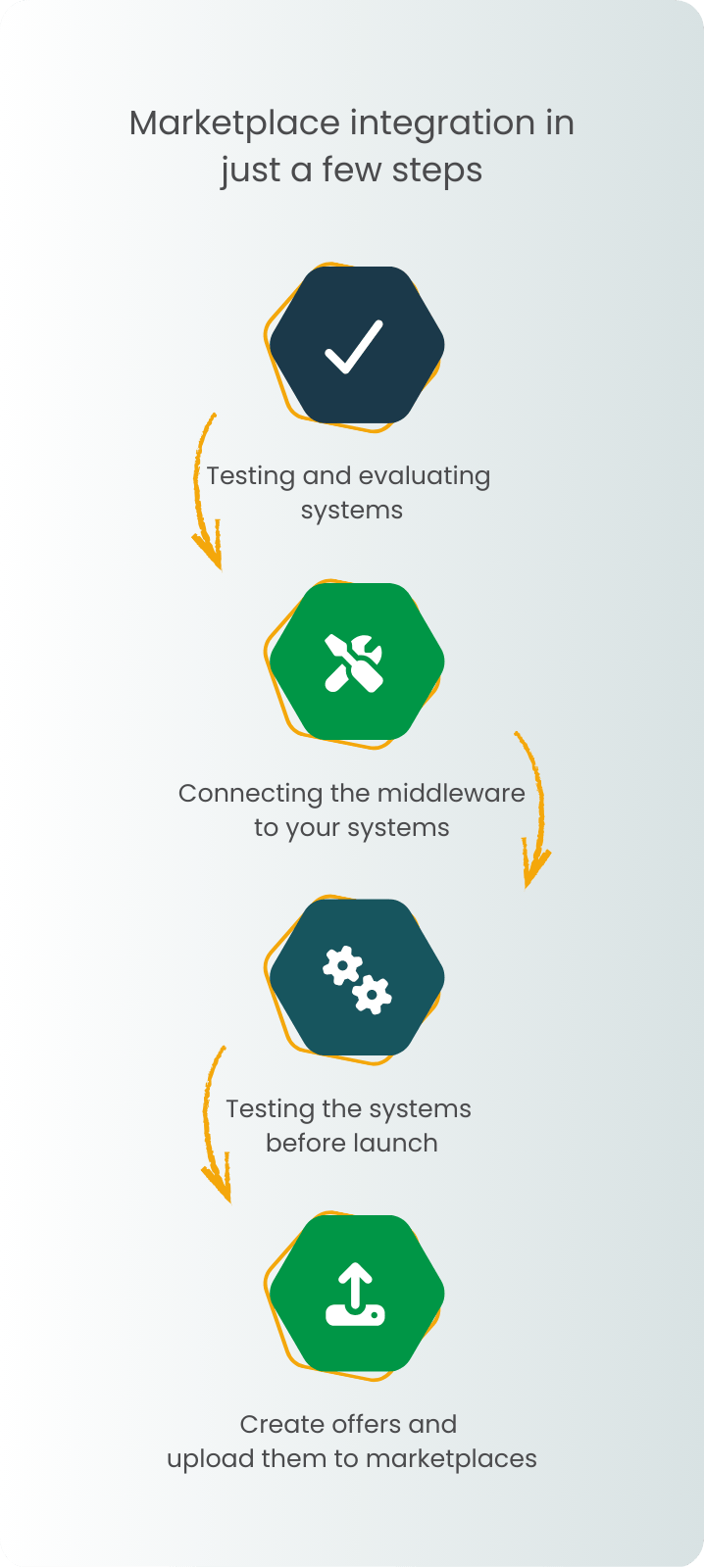
Marketplace integration in just a few steps!
The very first steps in using Speed4Trade CONNECT require a bit of time and care, so that you can later benefit more easily and quickly from the advantages of the middleware and our modular connection to online marketplaces such as eBay, Amazon, or Tyre24.
Step 1: Check systems & prepare middleware
Together with you, we review and assess the systems you use (e.g. ERP, PIM) and prepare the implementation of the Speed4Trade CONNECT middleware. Thanks to our many years of experience and existing modular integrations with common ERP systems, we focus on tailoring the solution to your specific requirements.
Step 2: Test integration and secure dataflow
The connection to your systems is thoroughly tested to ensure smooth two-way data flow and trouble-free operation in daily business.
Step 3: Connect marketplaces & go live
You are now ready to get started and can connect your first online marketplace! We are happy to support you in the initial steps of adapting your product information and offers to the new platform. This way, we ensure that you quickly feel at home using the middleware.
Still have questions afterwards? Of course, we’re happy to assist you and support you with any challenges or adjustments!
Reliable, user-friendly, scalable
Let us show you how to use the middleware. We are also happy to clarify in an initial consultation that Speed4Trade CONNECT is compatible with your IT systems and can process your product catalogues without any issues.
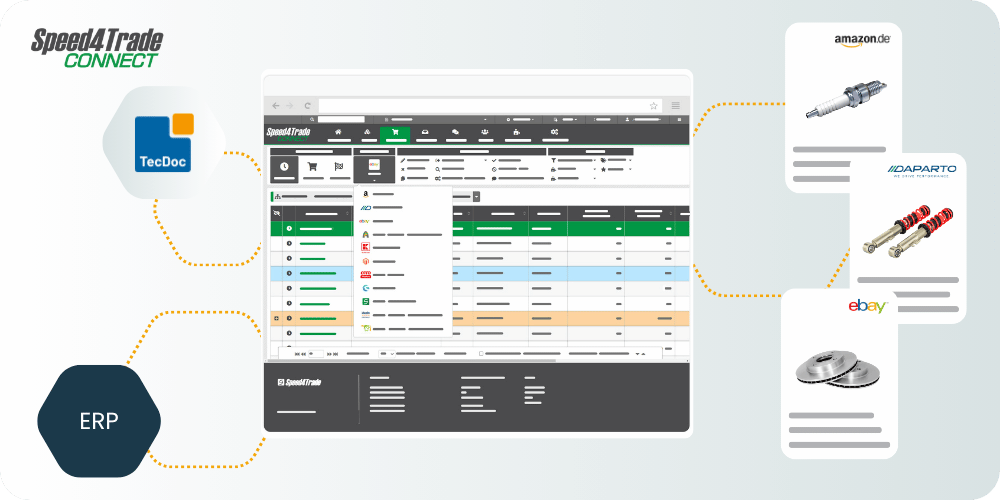
Reliable parts identification and precise search results
Especially in the automotive parts trade, it is essential that your listings are easy to find and contain complete information. Only then do you have a real chance of selling on leading online marketplaces such as eBay, Amazon, or DAPARTO.
TecDoc Catalogue data integration in Speed4Trade CONNECT
Integrating data from the TecDoc Catalogue makes it possible to use complete and complex product information efficiently across platforms. As a parts dealer, you can use the Speed4Trade CONNECT middleware to automatically generate detailed listings enriched with images, vehicle compatibility tables, and text attributes.
This ensures reliable parts identification and precise search results. Such data enrichment creates listings that have a positive impact on your sales figures.
Sales planning and automated listing
With Speed4Trade CONNECT, you can reach different customer groups using individually tailored sales strategies. Within the middleware, we provide you with customised listing templates – in your corporate design (eBay) – including modules and placeholders for text and product images.
At the same time, you can tailor categories, prices, payment methods, shipping costs, and other attributes individually for each marketplace. And with interactive stock reconciliation, the middleware ensures that inventory levels and quantity distribution are synchronised across all marketplaces and additional sales channels.
Effective product listing with Speed4Trade CONNECT
- Individual sales strategies possible
- Listing templates (eBay), modules, and placeholders for appealing offers
- Stock synchronisation prevents overselling
Control of order processing
Speed4Trade CONNECT provides you with an overview in a central system: all orders can be filtered by marketplace. The integration platform automatically retrieves all orders placed in the online shop and on marketplaces via an interface. This is a basic requirement for the fast dispatch of goods.
Centrally manage order processing in a single software solution
- Manage data within a central system
- Filter orders/purchases by marketplace
- Full support for all order workflows
Support for customer communication and after-sales processes
Speed4Trade CONNECT enables automatic communication with prospective and existing buyers, for example through status updates. In the after-sales area, processes that follow the purchase are managed and largely automated. You can make use of rating templates and define the point in time at which a positive review should be submitted to an eBay buyer. Topics such as cancelled orders or various discrepancies are also covered in this area, ensuring that you always maintain full control.
Benefit from online marketplaces with extensive reach
- Generate new sales opportunities
- Rapidly increase visibility and visitor numbers
- Minimise data management workload
- End-to-end processes
Buying behaviour has changed
Digitalisation and the success of e-commerce have changed — and continue to change — customer behaviour across all areas of the economy, both in the B2B and B2C sectors.
They compare prices, delivery times and service – and increasingly use online marketplaces where different providers offer similar products, making direct comparison possible.
What does that mean for retailers?
For you as a company, this means that you should offer your products and listings directly across as many platforms as possible. Whether on online marketplaces such as Amazon, eBay and Otto Market, or on specialised B2B platforms like Tyre24 and ALFAH Parts – if your products are not listed there, they remain invisible to many customers.
But how can you manage this without the effort of maintaining multiple marketplaces with varying requirements spiralling out of control? Meet the challenges of today’s digital purchasing landscape with the right digital strategy – connect your ERP system to all relevant marketplaces via a central middleware. We’ll show you how this creates real advantages and what you should keep in mind.
Book your consultation now
for your marketplace connections
What are marketplaces?
In this context, online marketplaces are platforms where various providers and retailers can showcase their products and offers and sell them directly.
The platforms generally offer providers extensive options to present their products – for example through photos, imagery, data sheets and product descriptions – and to define specific sales conditions within certain parameters.
For purchasers, the platforms frequently provide the possibility to compare products from various suppliers directly, thereby supporting well-founded purchasing decisions. In addition, it can be advantageous that the entire ordering and payment process is processed via the marketplace, so there is no need for customers to register with multiple providers and all orders remain neatly consolidated in one place.

What does marketplace integration mean?
Marketplace integration refers to linking online sales platforms such as Amazon, eBay or Conrad directly to your own ERP system through appropriate middleware.
As a retailer and provider, you not only use the online marketplace of the trading platform, but in this way also have the opportunity to reach all customers of this marketplace – including those who may not yet know your products.
Each platform represents a new sales channel, with every platform offering the chance for increased revenue at minimal effort and risk. Every marketplace acts like an additional online shop for you, without the need to deal with the details of a new shop system or technical solution – as all order processing takes place centrally in your own systems and requires hardly any extra work thanks to automation.
Our marketplace integration solution
Speed4Trade CONNECT connects you to the world’s largest and best-known
online marketplaces. Unlock new buyer audiences in just a few clicks!
Benefits of marketplace integration
Using multiple trading platforms offers your company and sales team several key benefits:
- Reach customers right where they're looking for products.
- Your customers shop in a familiar, trusted environment they know and rely on.
- You can offer customers all the payment options available on the platform that they are accustomed to.
- You can leverage the platforms' existing infrastructure to get started quickly and without hassle.
- New sales markets and customer segments can be tapped into flexibly and with minimal effort – at low investment risk.
- You benefit from the substantial, frequently international audience of the trading platforms.
- Huge potential for massive revenue growth.
How does the marketplace connection work?
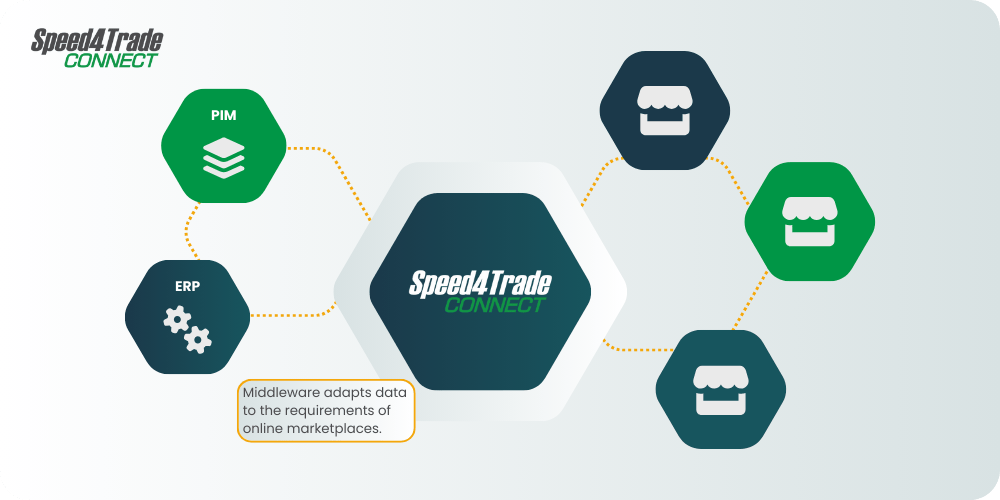
The elegance and advantage of marketplace integration lie in the fact that you only need to handle a few details manually. The main work is taken care of by software for you. The so-called middleware connects to your systems on one side and to the marketplaces‘ systems on the other via suitable interfaces. How exactly does this work?
In your own technical systems, ideally all the information required by external marketplaces is already available: detailed product data, stock levels, prices and much more. This data is forwarded to the middleware, which processes it and then transmits it to the marketplaces.
High-quality middleware ensures interfaces are optimally prepared and tailored to each marketplace, enabling largely automatic data mapping to the correct fields. This keeps your PIM system data unchanged, avoiding disruptions to other processes.
Nevertheless, it may be necessary or useful to enrich the data you send to Amazon or eBay. Marketplaces might offer categories and structures not covered in your product information. They may also allow links that can positively influence customer buying decisions. A key example is car spare parts, where it’s crucial to specify which exact models they fit.
With appropriate data enrichment and adaptation in the middleware, you provide customers on the platform with even more comprehensive information, thereby improving your chances of sales success.

Lott Autoteile: Central Multi-Channel E-Commerce Management
Lott Autoteile, our car parts specialist customer, sells across 12 platforms – from their own online shop and eBay to Amazon, DAPARTO, 07ZR and Tyre24. Everything’s centrally controlled through Speed4Trade CONNECT e-commerce middleware.
Requirements for a successful marketplace connection
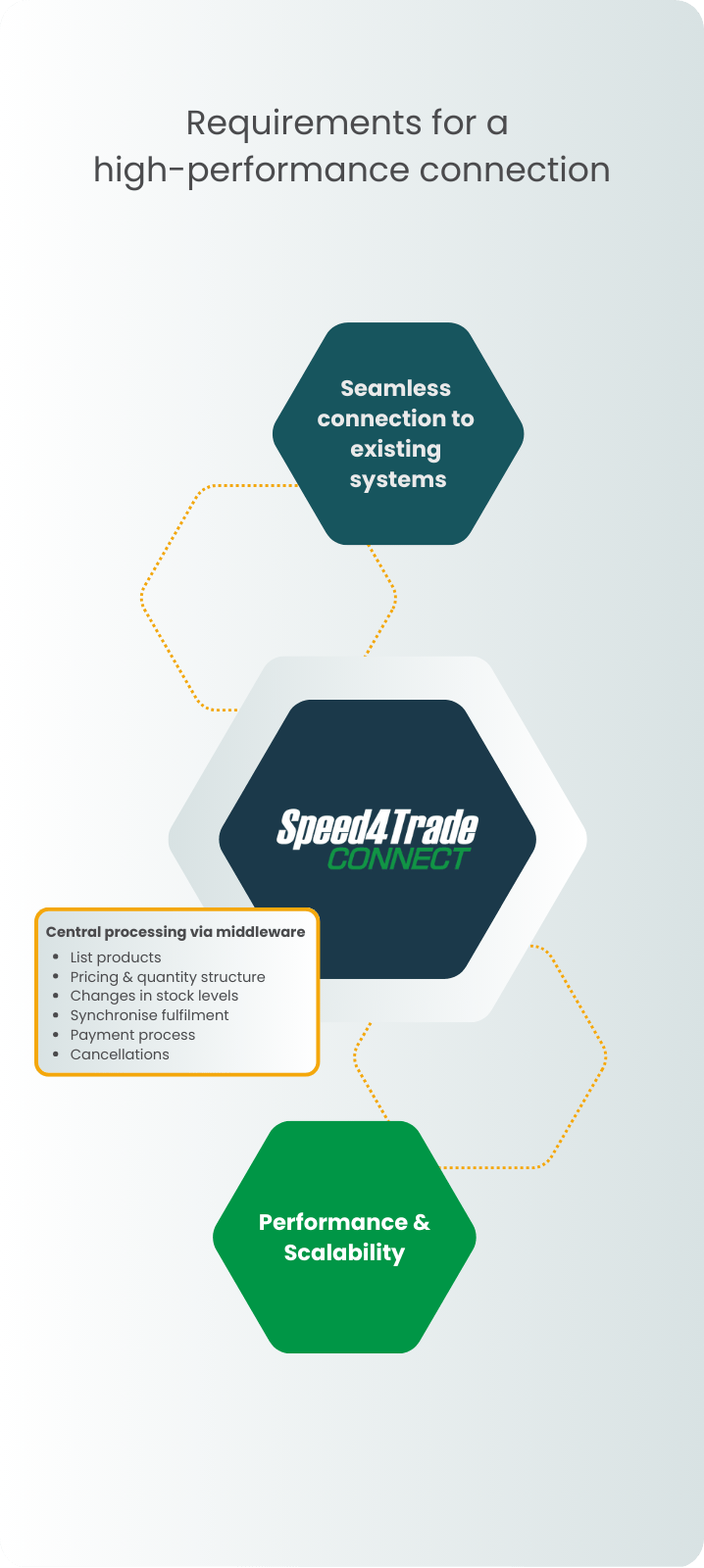
However, to ensure that using marketplaces is truly worthwhile for you, it is important that you can implement the connection with minimal effort. In particular, manual management of individual listings should not be necessary; instead, seamless connection to internal systems and processes is essential.
This means that marketplace integration works effectively when all sales process activities are centrally managed and handled via middleware (the software positioned between the marketplaces and your ERP system).
This includes:
- Product listing on marketplaces
- Price and quantity management
- Collection of orders by the ERP system
- Stock level monitoring and bidirectional updates
- Synchronisation of fulfilment and invoicing
- Payment processing with automated matching
- Cancellations including reverse processing for returns or credits
In order to truly take advantage of the opportunities offered by marketplace integration, it is important that you work with a system that can guarantee high performance.
Scalability is crucial: only if you can manage multiple marketplaces simultaneously with large product volumes and broad product ranges, and the synchronisation continues to function reliably and continuously, can you depend on the system. This is essential in many industries, such as the automotive sector.
Scalable high performance with Speed4Trade CONNECT
Our solution masters massive data and extreme customisation with ease. Serving clients with 3 million articles and more than 500,000 monthly orders through marketplaces.
Manage sales channels in one place
Marketplace integration offers huge potential to list your products across diverse platforms, paving the way for omni-channel commerce.
For success, offers across all sales channels must be kept continuously up to date – with minimal administrative effort and as few manual interventions as possible.
Ideally, all marketplaces are managed and overseen via a central e-commerce system – the middleware. Data from various systems flows directly into this middleware, giving you a comprehensive overview of all articles and orders across all marketplaces – including payment processing, shipping, and aftersales communication.
At the same time, the middleware automatically handles the exchange with your internal systems, ensuring that information on availability, stock levels, and much more is always kept up to date.
The marketplace integration system should therefore cover and unify all processes end-to-end.
A good system includes the following functionalities:
- Setting up products or articles including all variants
- Price and quantity management (also marketplace-specific)
- Automated assignment to corresponding categories within the marketplaces (tailored to each platform’s specific requirements)
- Automated payment and shipping processing
- Aftersales
- Integration options with payment and shipping providers, CRM, PIM, etc.
Want to connect a new marketplace? With robust middleware, you can easily add more platforms – the software provider handles the integration for you. This lets you quickly list products, manage orders, or handle payments.
Seamless process integration
You already work with a proven IT infrastructure and an established ERP system – with a successful marketplace integration, the middleware handles communication between your existing systems and the various marketplaces.
A modular system is best suited for this purpose, as it can be seamlessly integrated into your business processes and system landscape with the appropriate components. For new marketplaces, corresponding modules can then be retrofitted or added, allowing you to respond flexibly and quickly to new requirements and challenges.
This ensures you always keep track of your stock levels even with orders on external marketplaces and can act and respond without any time delay.
Since selling via marketplaces involves numerous areas of your business—such as IT, sales, accounting, and product management—achieving deep integration into your own systems is crucially important, ensuring information is always exchanged automatically, seamlessly, error-free, and in real time.
Expand sales strategies
By linking your channels and expanding your sales to external platforms, you also gain the opportunity to implement new sales strategies.
Companies with numerous sales outlets can, for example, enable innovative models like „Click & Collect“ on eBay by integrating their dealer networks into these processes. Goods can then be ordered online via marketplaces and collected directly from the retailer in the local branch – offering an ideal opportunity to sell additional services on site and provide customer advice.
Automotive clients leverage it to deliver assembly and repair services across dealerships, partners, and workshop networks.
You also have the option to adjust your pricing by platform – always aligned with your business strategy and the specific marketplace conditions. Naturally, every online marketplace where you are present offers its own new marketing opportunities – directly on the platform, via SEA, or other channels.
Tap into new markets – with minimal risk
Once a suitable middleware is fundamentally set up for accessing online marketplaces, interfaces to individual platforms can typically be added without significant effort or cost. Online marketplaces are therefore ideal for testing new markets with minimal risk and low investment – whether to tap into new customer segments or trial a new international market.
An example: you’re already using eBay to sell your goods, but haven’t yet utilised Amazon or OTTO Market?
Connecting to these platforms can be done in just a few simple steps and adjustments – and the figures will very quickly show whether the experiment was really worthwhile. The effort involved remains minimal, as you interact directly via the middleware as usual. However, all revenue generated goes directly to you.
At the same time, you can observe your customers‘ behaviour across the various platforms and systematically refine each sales strategy step by step based on these insights.
Would you like to learn more about selling on online marketplaces?
Data management
For marketplace integration to truly succeed, one topic is particularly important: effective data management.
The middleware needs to supply each marketplace with all the information it uses. It does so by retrieving data from your PIM system and tailoring it to the different online marketplaces. To achieve this, data from your own system must be mapped to the categories of each individual channel.
For automated sales processes to run smoothly, it’s important to connect your ERP or stock management system. This prevents overselling and allows order and delivery times to be transferred accurately.
Flexible technology
A modular middleware solution will allow integration with both the ERP system and multiple marketplaces via API-based connections.
Should adjustments be required, for instance if a marketplace revises its categories or your ERP system needs updating, it is only the relevant interface, in other words, individual modules, that must be updated. This minimises effort and allows you to react swiftly and flexibly to changes.
Thanks to its modular design, additional platforms can easily be integrated into the system, even on a temporary basis. The relevant module automatically handles all necessary interfaces without any technical effort.
Scalable. Modular. Integrated. Experience Speed4Trade CONNECT.
Our tried-and-tested, flexible solution for integrating online marketplaces offers everything you need to grow your sales successfully. See the power of our middleware, Speed4Trade CONNECT, in action – we’d be delighted to show you more.
Excerpt from our customer references
The Speed4Trade experts have successfully delivered a wide range of customer projects.




























Speed4Trade: Your partner for successful digital platforms since 2005
For more than 20 years, we have been guiding our clients through all phases of their digital transformation, enabling them to build closer customer relationships and boost sales – efficiently, securely, and with reduced costs.
Discover our e-commerce solution for marketplace integration and get expert, no-obligation advice from the Speed4Trade team.
Häufige Fragen (FAQ)
1. What is a marketplace connection?
A marketplace connection refers to the technical link between an online marketplace and a company’s central systems, such as ERP, inventory management or PIM. It provides the basis for the automated exchange of product data, prices, stock levels and orders. A marketplace integration goes one step further: it integrates the marketplace into existing data and business processes, enabling end-to-end workflows across multiple systems. Middleware such as Speed4Trade CONNECT handles the central data exchange in this process. In practice, however, the terms ‘marketplace connection’ and ‘marketplace integration’ are often used interchangeably.
2. How does marketplace integration work?
In a marketplace integration, online marketplaces are connected to existing systems such as ERP, inventory management or PIM via interfaces and centralised middleware. Speed4Trade CONNECT consolidates relevant data from these systems, formats it in accordance with the requirements of the respective sales channel, and transfers data such as product and offer details, prices and stock levels to the marketplaces. Incoming orders are retrieved centrally and forwarded to the connected systems for further processing. Depending on the sales channel, dispatch and status information can also be fed back. This results in automated, cross-system e-commerce processes.
3. Which marketplaces can be integrated?
Speed4Trade CONNECT enables centralised integration with numerous relevant B2B and B2C marketplaces and sales platforms. These include, amongst others, Amazon, eBay, Kaufland, OTTO Market, AUTODOC MARKETPLACE, DAPARTO, CHECK24, Tyre24, 07ZR and ALFAH Parts. Depending on the platform, the middleware supports various processes such as the transfer of product listings, price and stock updates, and centralised order processing. Furthermore, additional marketplaces and sales channels can be integrated on an individual basis. This allows the marketplace strategy to be flexibly expanded to include additional sales channels.
4. Which ERP systems can be integrated?
Speed4Trade CONNECT enables various ERP and merchandise management systems to be connected to the linked marketplaces. Integration takes place via suitable interfaces and is tailored to the existing system landscape and the relevant business processes. For example, product, price and stock data can be imported from the lead system, and marketplace orders can be fed back for further processing. In addition to ERP and inventory management systems, other systems such as PIM solutions can also be integrated. This allows Speed4Trade CONNECT to be flexibly integrated into existing IT landscapes.
5. Which processes can be automated through a marketplace integration?
A marketplace connection enables the automation of key processes in digital sales, from the creation and updating of quotations to order fulfilment. Speed4Trade CONNECT consolidates relevant data from connected systems and formats it to suit the respective marketplace, online shop or other sales channels. Product data and prices can be transferred and updated automatically. An intelligent stock reconciliation system keeps available quantities up to date across all channels and reduces the risk of overselling. Incoming orders are retrieved centrally. Depending on the sales channel, dispatch information and status updates can also be transferred.
6. How are stock levels automatically synchronised with the marketplaces?
With Speed4Trade CONNECT, stock levels are automatically synchronised between the lead system and the connected marketplaces or sales channels. Changes in stock levels are processed and the available quantities are transmitted to the relevant channels accordingly. If the available stock changes, Speed4Trade CONNECT takes this change into account during the stock reconciliation and updates the quantities on offer. This ensures that stock levels remain as up-to-date as possible across all channels, reduces the need for manual stock corrections and minimises the risk of overselling.
7. How are orders from marketplaces processed?
Orders from connected marketplaces are automatically retrieved using Speed4Trade CONNECT, processed centrally and transferred to the connected ERP or stock management system. The middleware consolidates orders from different sales channels into a single centralised process, thereby reducing the need for manual processing. Relevant order data is thus available in the core system for further processing. Depending on the connected marketplace, dispatch and status information can subsequently be transferred back to the respective sales channel. This creates an end-to-end process from order receipt through to processing and the feedback of relevant information.
8. How is product data transferred to marketplaces?
With Speed4Trade CONNECT, product data is automatically imported from connected systems – such as a PIM system – prepared for the relevant sales channel and transferred to the marketplaces. In doing so, the platform’s specific requirements for product and offer data are taken into account. Product data is consolidated and made available for marketplace-compliant offers. Product information, images, text and other attributes can be transferred accordingly. In the automotive aftermarket, data from the TecDoc Catalogue can also be used to enrich product data. This enables even large product ranges to be marketed efficiently across various online sales channels.
9. How can prices be managed automatically across different marketplaces?
With Speed4Trade CONNECT, prices can be managed centrally and automatically transferred to the connected marketplaces and sales channels. Based on the price information stored in the main system, retail prices can be controlled and updated on a channel-by-channel basis. Depending on the sales channel, different prices, price lists and channel-specific price information can be taken into account. Depending on the platform in question, special or promotional prices can also be transferred. This means that price changes do not have to be maintained individually on each marketplace. This reduces the amount of manual work and simplifies centralised price management across multiple channels.
10. How are oversales prevented on marketplaces?
The risk of overselling on marketplaces can be significantly reduced through automated stock synchronisation. Speed4Trade CONNECT processes stock changes and updates the available quantities on the relevant marketplaces and online shops. If the availability of an item changes, this is taken into account during stock synchronisation and automatically communicated to the connected sales channels. This ensures that the quantities on offer remain as up to date as possible across all channels. This minimises the risk of selling items that are no longer available, whilst also reducing the manual effort involved in stock management.
11. What is the difference between middleware and a custom interface?
Middleware connects multiple systems and sales channels via a central software solution, whilst a bespoke interface usually establishes a direct connection between two systems. Using middleware such as Speed4Trade CONNECT, for example, ERP, PIM and inventory management systems can be linked to multiple marketplaces and online shops. Data and processes are centrally consolidated, processed and transferred to the respective channels. This reduces the number of point-to-point connections that need to be developed and maintained individually and can minimise sources of error in data integration. Furthermore, additional sales channels can be integrated more easily.
12. What are the benefits of using middleware for marketplace integration?
Marketplace integration middleware enables multiple marketplaces, online shops and internal systems to be connected centrally and sales processes to be automated. With Speed4Trade CONNECT, product and offer data, prices, stock levels and orders are processed and synchronised across all channels. This reduces the need for manual maintenance and the risk of errors during data transfer. At the same time, new sales channels can be integrated more easily into the existing system landscape. This enables companies to manage their multichannel business more efficiently and scale their sales activities via a central software solution.
13. What should you bear in mind when integrating with a marketplace?
When integrating with marketplaces, particular attention should be paid to reliable interfaces, automated processes, high data quality and the solution’s scalability. Product and offer data, prices, stock levels and orders must be exchanged reliably between the ERP, PIM or retail management system and the connected sales channels. Equally important are automated stock reconciliation, support for large product ranges and the flexible integration of further marketplaces. Changes to APIs and the platforms’ technical requirements should also be reliably accommodated. Centralised middleware reduces the complexity of numerous individual point-to-point connections.
14. Which features should professional marketplace software offer?
Professional marketplace software should be able to automatically map and manage the core processes for sales across multiple online marketplaces. This includes the channel-specific creation and updating of listings, the transfer of product data, price management and reliable stock reconciliation to minimise overselling. Equally important are the centralised processing of orders, the consideration of marketplace-specific requirements, and the integration of existing systems such as ERP, inventory management or PIM. Speed4Trade CONNECT combines these functions in a centralised middleware solution and supports companies in managing their marketplace business efficiently and scalably.
15. When is it worth connecting to a marketplace?
Integrating with marketplaces is particularly beneficial for businesses that wish to efficiently manage multiple sales channels, consolidate data from different systems and automate recurring processes. As the number of marketplaces, products and orders increases, so does the effort required to manually maintain listings, prices and stock levels, as well as to process orders. Centralised middleware such as Speed4Trade CONNECT consolidates these processes and connects the sales channels to existing systems such as ERP, inventory management or PIM. This reduces manual tasks, enables processes to be scaled and makes it easier to integrate additional marketplaces.
16. What are the costs involved in connecting to a marketplace?
The cost of a marketplace integration depends on the specific scope of the project, the systems and sales channels to be connected, and the required functions. Factors influencing the cost include, for example, the existing ERP, inventory management or PIM infrastructure, the number and requirements of the desired marketplaces, and any necessary customisations and interfaces. Depending on the project, costs will arise for the software, implementation and integration, as well as ongoing operations. It is therefore not possible to provide a flat-rate quote. At Speed4Trade, we first analyse requirements and processes in order to determine a suitable solution and the specific scope of the project.
17. Is a marketplace integration also suitable for large product ranges and high order volumes?
Yes, a professional marketplace integration can also be designed to handle large product ranges and high order volumes. Speed4Trade CONNECT really comes into its own when dealing with extensive product ranges and large volumes of data: the middleware processes product and offer data, prices, stock levels and orders centrally, and automates the associated processes across multiple sales channels. This enables extensive product ranges to be managed efficiently without a corresponding increase in manual effort. The specific system architecture and design are tailored to the company’s individual requirements, data volumes and processes.
18. How are changes to the marketplaces’ APIs taken into account?
Changes to the APIs of connected marketplaces are taken into account by Speed4Trade as part of the ongoing development and maintenance of the respective marketplace integrations. If a marketplace changes its technical interfaces or relevant requirements, the corresponding integration is adapted. This means that businesses do not have to implement such changes themselves in individual interfaces for each sales channel. This reduces the technical maintenance workload and supports reliable and stable data exchange between their own systems and the connected marketplaces.